
 By
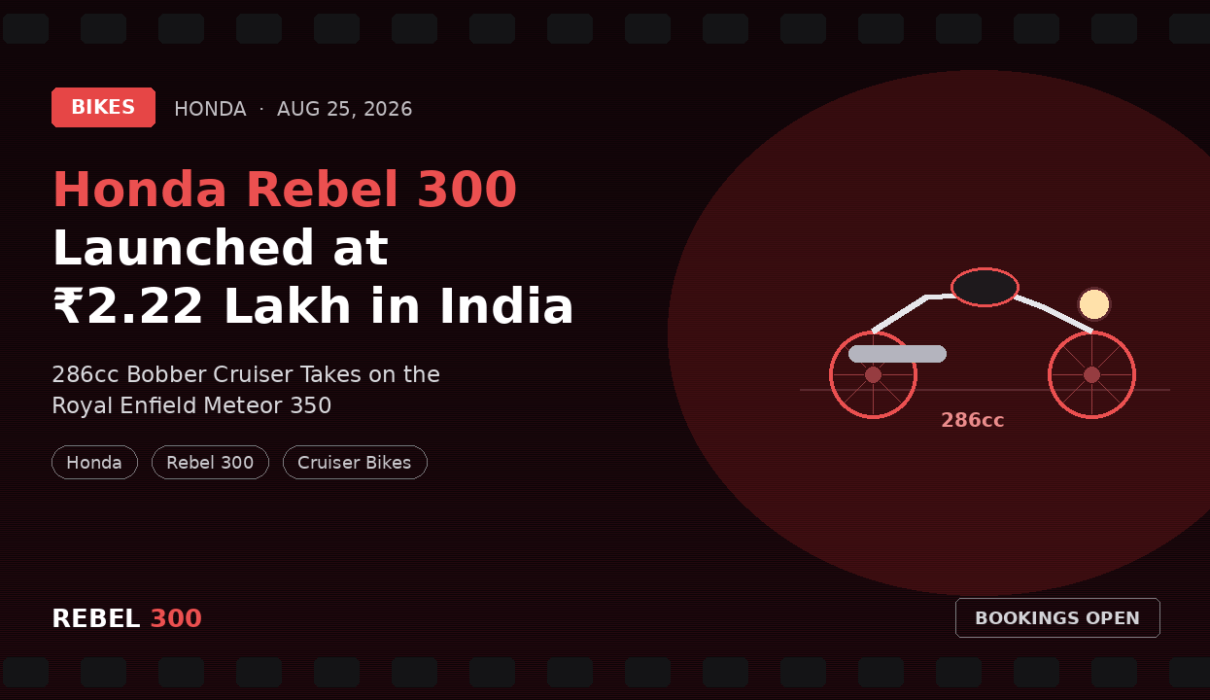
By The entry-level cruiser segment has witnessed a major shift, and the arrival of the Honda Rebel 300 has immediately captured the attention of motorcycle enthusiasts.
For decades, mid-capacity cruising has been dominated by classic, heavy retro machines that favor chrome accents and vintage silhouettes. While those heritage models have their charm, many urban commuters and new riders often find their heavy curb weight, tall seats, and sluggish city handling intimidating. The Honda Rebel 300 takes a radically modern approach by blending lean bobber styling, approachable ergonomics, a responsive liquid-cooled powertrain, and cutting-edge electronic transmission options into a nimble everyday motorcycle.
Whether you are stepping up to your first proper highway cruiser, seeking an agile daily commuter for congested city streets, or simply looking for an authentic custom-style bobber that requires minimal maintenance, this extensive review breaks down the performance, ergonomics, real-world mileage, ownership costs, and pricing details of the Honda Rebel 300.
1. Distinct Modern Bobber Styling and Road Presence
The first thing you notice about the Honda Rebel 300 is its stripped-down, aggressive stance. Instead of following the traditional formula of excessive chrome badges, wide swept-back fenders, and vintage paint schemes, this motorcycle embraces an authentic blacked-out bobber design.
- Narrow Tubular Steel Trellis Frame: The custom-style frame wraps tightly around the dark engine block, creating an exposed, mechanical aesthetic that looks custom-built straight from the factory.
- Teardrop Fuel Tank: The sharply raked 11.2-liter fuel tank sits high on the backbone, angling downward sharply toward the deeply scooped solo saddle to create a classic cruiser silhouette.
- Chunky Front and Rear Tires: The Honda Rebel 300 rolls on fat 130/90-16 front and 150/80-16 rear tubeless tires mounted on multi-spoke cast aluminum alloy wheels, giving the bike a planted, muscular road stance.
- Quad-LED Circular Headlamp: Up front, a clean round headlamp housing incorporates four bright LED projector units surrounded by a black bezel, delivering crisp nighttime illumination with contemporary styling.
The minimalist tail section with an LED stoplamp and clean fender lines ensures that the motorcycle looks modern from every angle, making the Honda Rebel 300 stand out in any parking lot.
2. Ultra-Low Seat Height and Welcoming Ergonomics
One of the greatest engineering strengths of the Honda Rebel 300 is its exceptionally approachable riding geometry. Cruiser motorcycles are meant to build confidence, and this chassis is designed to make riders of all physical builds feel instantly in control.
The 690 mm Low-Slung Saddle
Seat height is often the deciding factor for beginners and shorter riders. The Honda Rebel 300 offers an ultra-low seat height of just 690 mm (27.2 inches). This enables virtually any rider to place both feet firmly flat on the pavement at traffic signals, completely eliminating the awkward balancing anxiety often experienced on taller adventure tourers or streetfighters.
Relaxed Riding Triangle
- Mid-Mounted Footpegs: Unlike traditional American-style long cruisers that stretch your legs far out to forward controls, the Honda Rebel 300 positions its footpegs neutrally in the mid-section. This setup supports your lower back and reduces fatigue over long city commutes.
- Natural Handlebar Reach: The wide, flat handlebar pulls back gently toward the rider, allowing you to maintain an upright, neutral spine posture without hunching forward.
- Manageable Curb Weight: Tipping the scales at a light and manageable curb weight of around 170 kg to 191 kg (depending on specific accessory trims and crash guards), pushing the bike in tight parking spaces is effortless.
For in-depth dyno testing charts, braking distances, and handling comparisons across entry cruisers, you can explore the technical reviews on Motorcycle.com.
3. Proven 286cc Liquid-Cooled Engine Performance
Beneath the minimalist frame of the Honda Rebel 300 sits a refined 286cc single-cylinder, 4-stroke, liquid-cooled, DOHC engine equipped with programmed fuel injection (PGM-FI).
- Power Output: Produces a punchy 29.5 BHP of peak power alongside 27.5 Nm of torque, tuned specifically for accessible low-end grunt and usable mid-range thrust.
- Liquid Cooling Efficiency: Unlike basic air-cooled cruisers that radiate uncomfortable heat toward your thighs in stop-and-go summer traffic, the radiator and cooling system on the Honda Rebel 300 keep engine temperatures remarkably stable.
- Vibration Management: An internal gear-driven counterbalance shaft effectively neutralizes high-frequency vibrations, ensuring mirror clarity and handlebar smoothness across highway cruising speeds between 90 km/h and 110 km/h.
- Highway Touring Capability: Mated to a crisp 6-speed gearbox, the motorcycle cruises smoothly at triple-digit speeds without sounding strained, while still offering enough reserve power for quick overtakes.
4. Revolutionary E-Clutch Technology: Changing the Game
A major technological leap forward for the Honda Rebel 300 is the availability of Honda’s groundbreaking E-Clutch system.
The electronic clutch management system acts as an intelligent bridge between a traditional manual gearbox and a fully automatic transmission:
- Stall-Free City Riding: With the E-Clutch engaged on the Honda Rebel 300, you can come to a complete stop in gear without touching the clutch lever, and simply roll on the throttle to pull away smoothly.
- Clutchless Gear Shifts: Riders can shift up or down through the 6-speed transmission using just the foot lever without pulling the handlebar clutch, making stop-and-go rush hour commuting completely effortless.
- Full Manual Override at Any Time: If you prefer traditional riding, grabbing the physical clutch lever on the Honda Rebel 300 instantly overrides the electronic system, giving you complete manual modulation whenever you want it.
This dual capability makes the motorcycle extraordinarily friendly for newcomers learning gear shifts, while still offering experienced riders total manual engagement on twisty backroads.
5. Suspension, Brakes, and Everyday Ride Quality
A stylish cruiser must also deliver dependable road manners over uneven asphalt and road expansion joints. The chassis and cycle parts on the Honda Rebel 300 are engineered to absorb urban bumps while maintaining stability in high-speed corners.
Suspension Hardware
- Front Telescopic Forks: 41 mm sturdy front forks provide 121 mm of smooth wheel travel, soaking up potholes and speed breakers without harsh bottoming out.
- Dual Rear Shocks: Twin rear shock absorbers feature 5-step adjustable spring preload, allowing you to easily adjust stiffness whether carrying luggage or riding solo.
Braking and Safety Features
- Large Disc Setup: A 296 mm hydraulic front disc paired with a 240 mm rear disc provides progressive, confidence-inspiring stopping power.
- Dual-Channel ABS: Comes standard on the Honda Rebel 300, preventing wheel lockup during emergency braking on wet asphalt or loose gravel.
- Single-Pod Digital Console: A compact round reverse-LCD gauge displays a digital speedometer, gear position indicator, fuel level, clock, and trip meters clearly under direct sunlight.
6. Real-World Fuel Economy and Low Maintenance Costs
Running costs represent a vital factor for everyday motorcycle owners. The Honda Rebel 300 delivers strong long-term ownership value thanks to its efficient fuel injection mapping and proven mechanical reliability.
- Expected Real-World Mileage: In mixed riding conditions (combining dense city traffic and open highway stretches), the Honda Rebel 300 consistently delivers 30 km/l to 35 km/l.
- Highway Touring Range: With its 11.2-liter fuel tank, riders can comfortably expect a realistic highway riding range of roughly 320 to 350 kilometers between fuel fill-ups.
- Accessible Spare Parts and Service: Because the 286cc engine platform shares internal components and architectural engineering with other trusted Honda models, routine maintenance, oil filters, brake pads, and general service remain highly affordable.
7. Pricing in India, Variants, and Market Competition
The launch of the Honda Rebel 300 in India has created an exciting alternative in the sub-500cc cruiser segment, distributed through premium Honda BigWing dealerships.
Variant Pricing Structure
- Honda Rebel 300 Standard Variant: Positioned at an attractive ex-showroom price starting around Rs. 2.22 Lakh, offering the core bobber chassis, liquid-cooled engine, and dual-channel ABS.
- Honda Rebel 300 E-Clutch Variant: Priced at approximately Rs. 2.62 Lakh (ex-showroom), adding automated electronic clutch control for effortless urban riding.
How It Compares to the Competition
- Versus Royal Enfield Meteor 350: The Meteor 350 offers a traditional heavy retro stance with an air-cooled motor, but the Honda Rebel 300 provides significantly higher horsepower (29.5 BHP vs 20.2 BHP), a lighter chassis, modern liquid cooling, and optional E-Clutch technology.
- Versus Jawa 42 Bobber: While the Jawa offers aggressive single-seat bobber styling, the Honda Rebel 300 excels in long-term engine refinement, smoother gear transitions, lower vibration levels, and higher build quality.
Final Verdict: Is the Honda Rebel 300 Right for You?
The Honda Rebel 300 redefines what an entry-level cruiser can be. By discarding heavy vintage chrome in favor of a clean, blacked-out bobber design, it creates a unique identity that appeals to both beginner riders and experienced motorcyclists.
With its ultra-low 690 mm seat height, smooth 286cc liquid-cooled engine, optional cutting-edge E-Clutch system, and legendary reliability, the Honda Rebel 300 delivers an easy-to-ride, stylish, and highly practical cruiser package that excels on daily city commutes and weekend highway getaways alike.
For more in-depth automotive reviews, upcoming motorcycle launches, and unbiased buying guides, explore our latest coverage on Around Us World.