
 By
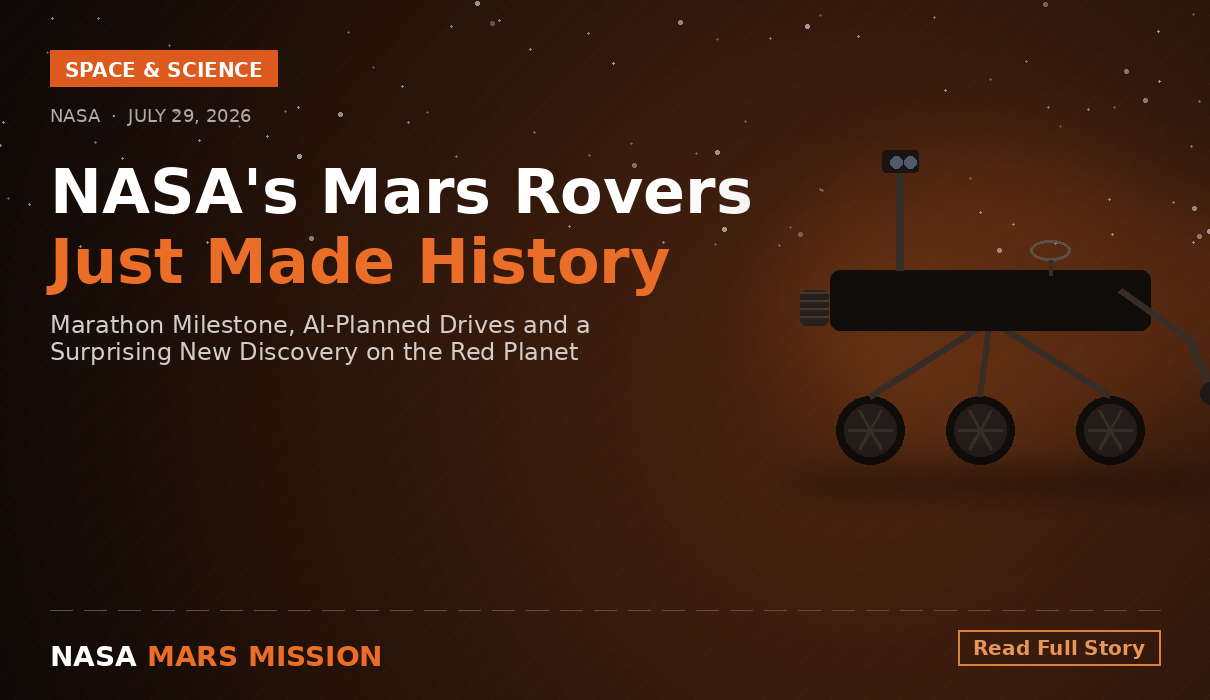
By NASA Mars rover missions just had their biggest month yet, and I’ve been trying to keep up with all of it. If you haven’t been paying attention to Mars lately, now’s the time to start. In the span of about six weeks, NASA’s two rovers—Curiosity and Perseverance—have pulled off a marathon, started driving themselves using AI, and stumbled onto a landscape feature that left even veteran scientists surprised.
Let me walk you through what’s actually happening up there.
Perseverance Just Ran a Marathon (Literally)
On June 14, 2026, NASA’s Perseverance rover crossed a genuinely wild milestone—it had driven a full marathon distance, 26.2 miles, on the surface of Mars. NASA’s Mars Reconnaissance Orbiter caught the moment from above, snapping an image of the rover as a tiny green speck against the Martian landscape the day before it crossed the finish line.
Here’s what makes this genuinely impressive: Perseverance covered that distance in five years and four months. The previous record holder, NASA’s Opportunity rover, took eleven years and two months to cover the same distance. That’s not a small improvement—it’s more than double the speed, on the same planet, with the same fundamental transportation challenge (six wheels, rocky terrain, dust storms, and zero help from a tow truck if something goes wrong).
Part of the reason for that speed jump comes down to how Perseverance drives. Unlike older rovers, Perseverance uses an autonomous navigation system that lets it re-plan its route around obstacles without waiting for instructions from Earth. And that system just got a serious upgrade.
Perseverance Can Now Find Itself Without Calling Home
Here’s a detail that doesn’t get enough attention: Mars is far away. Really far. Radio signals between Earth and Mars take anywhere from 4 to 24 minutes one-way, depending on where the planets are in their orbits. That means real-time joystick control of a rover is physically impossible. Every command has to be pre-planned, sent, and then you wait to see what happened.
JPL engineers just made that problem smaller. A new system called Mars Global Localization lets Perseverance figure out exactly where it is without needing help from mission control on Earth. The technology works by comparing panoramic images from the rover’s navigation cameras against onboard orbital terrain maps, and it can pinpoint the rover’s location within about 10 inches in roughly two minutes.
Why does this matter? Because Perseverance’s self-driving system had gotten so good at planning routes around obstacles that the rover’s own uncertainty about its exact location became the limiting factor on how far it could travel unsupervised. Now that it can verify its own position on the fly, it can be sent on longer autonomous drives without needing a check-in from Earth every few hundred feet.
The AI Drove the Whole Route
This is the part that sounds like science fiction but genuinely happened. In late January 2026, Perseverance completed the first Mars drives that were planned entirely by artificial intelligence rather than human rover operators.
The system used a vision-capable AI that analyzed the same kind of images and terrain data that human planners normally use, identifying hazards like rocks and sand ripples, and then charting a safe path across the surface. After the AI’s routes were tested extensively in a virtual simulation of the rover, Perseverance successfully followed the AI-generated paths, traveling hundreds of feet without human-planned routing.
This is a genuinely big deal for how future missions get designed. Human rover planners at JPL spend hours mapping out safe routes, sol by sol, working around communication delays and terrain hazards. If AI can reliably take over even part of that job, it means rovers can cover more ground, explore further, and waste less time waiting on human planning cycles back on Earth.
Curiosity Found Something Nobody Expected
Meanwhile, on the other side of Mars, Curiosity has been having its own moment. The rover recently discovered a massive field of honeycomb-shaped textures on the Martian surface—polygon patterns that stretch across the terrain and even wrap around the sides of a nearby butte the team nicknamed “Miraflores.”
Project scientist Ashwin Vasavada of JPL, who’s been working on this mission for years, said the team has seen a lot of striking landscapes through Curiosity’s cameras, but this field of polygons genuinely surprised them. That’s not a small statement coming from someone who’s been staring at Mars imagery for over a decade.
Polygon and honeycomb-shaped ground patterns usually form through some kind of repeated environmental cycle—wetting and drying, or freezing and thawing, cracking the surface into geometric patterns over long periods. Finding a massive field of them adds another data point to the ongoing question of what Mars’s climate and geological history actually looked like, and how much water shaped the planet over time.
The Bad News: Mars Sample Return Is Basically Dead
Not everything from the past few months has been a win. In January 2026, a congressional spending bill effectively ended NASA’s Mars Sample Return program, following a White House recommendation to cancel it in favor of prioritizing eventual human missions to Mars.
This matters because Perseverance has spent years carefully collecting and caching rock and soil samples specifically designed to be picked up by a future mission and brought back to Earth for detailed lab analysis—the kind of analysis you simply can’t do with a rover’s onboard instruments, no matter how sophisticated they are. Congress redirected 110 million dollars into a new program aimed at preserving some of the underlying technology, but the practical result is that Perseverance’s collected samples are sitting on Mars with no confirmed plan to bring them home.
The rover itself is fine. The science mission continues. But the sample-return architecture that was supposed to be the payoff for years of careful sample collection doesn’t currently exist in any funded form. It’s the kind of decision that reshuffles priorities across the entire Mars exploration roadmap, and it’s worth watching what (if anything) replaces it.
Why This Moment Matters
Put all of this together and you get a picture of where Mars exploration actually stands in mid-2026: two rovers still working after a combined nine-plus years on the surface, a navigation system getting smart enough to operate with less oversight from Earth, AI taking over parts of a job that used to require entire planning teams, and a genuinely surprising geological discovery that raises new questions about the planet’s past.
At the same time, the bigger, more ambitious sample-return plan that was supposed to be the crown jewel of this era of Mars science has been shelved, at least for now. That tension—incredible technical progress on the ground, uncertain political and budgetary support for the next big step—is basically the story of Mars exploration in 2026.
The rovers aren’t going anywhere. Curiosity and Perseverance are both still healthy, still driving, still finding things nobody expected. Whether the next phase of Mars exploration includes bringing any of that data home in physical form is a question that’s still very much unresolved.
What do you think—does the AI-driving breakthrough excite you more than the marathon milestone, or is the honeycomb discovery the real story here? Let me know in the comments.
Sources: NASA, JPL (Jet Propulsion Laboratory), Space.com, ScienceDaily, ISDC (International Space Development Conference)