
 By
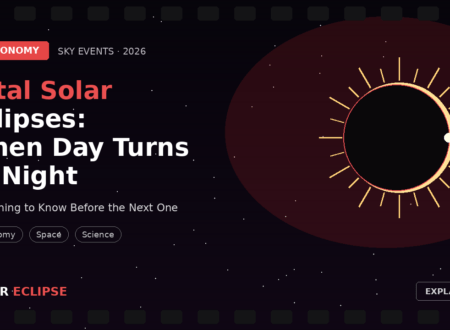
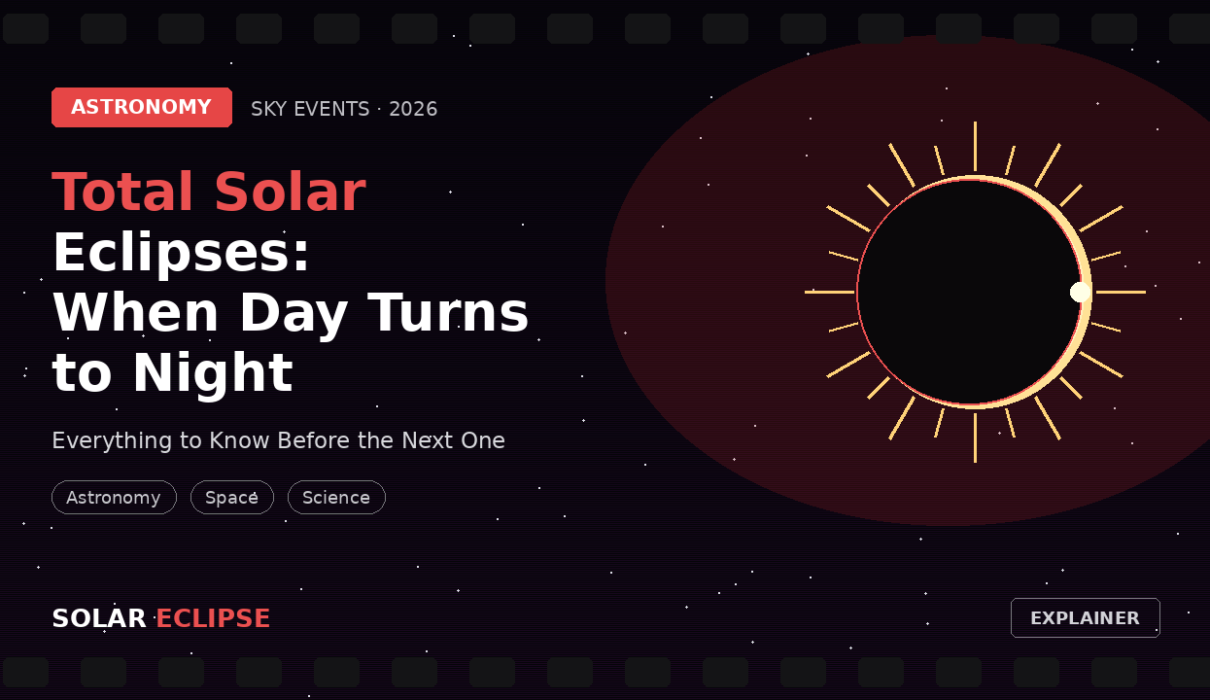
By Total Solar Eclipse 2026: Remember the last time we all rushed to the terrace with those flimsy sunglasses? That was April 2024. Now, after more than 2 years, a total solar eclipse is finally happening again on August 12, 2026. And this one is special — because it is happening over Europe and the Atlantic, with a rare sunset eclipse in Spain! If you are a skywatcher or just someone who loves cool cosmic events, this guide is for you. Let’s check all the details of this Total Solar Eclipse 2026 in simple words.
Total Solar Eclipse 2026: Date and Time
Mark your calendars for Wednesday, August 12, 2026. This is the first total solar eclipse visible from continental Europe since 1999. That is 27 years, friends!
Global Timings (UTC):
- Partial eclipse begins – 15:37 UTC
- Greatest eclipse – 17:46 UTC
- Partial eclipse ends – 19:52 UTC
Timings in India (IST):
- Partial eclipse begins – 9:07 PM IST on August 12
- Greatest eclipse – 11:16 PM IST on August 12
- Partial eclipse ends – 1:22 AM IST on August 13
But here is the sad part for us in India — the Sun will be below the horizon during these times. So we will not see it directly.
Total Solar Eclipse 2026: Where to See It? (Path of Totality)
The Moon’s shadow will travel for about 4 to 5 hours across the Northern Hemisphere. If you are in these places, you are lucky!
Where you can see the total eclipse (Moon completely covers the Sun):
- Greenland – eastern and southern coastlines
- Iceland – western and southern regions, including Reykjavik
- Northern Spain – cities like León, Burgos, Valladolid, Bilbao, Zaragoza, Valencia, and Palma
- Extreme northeastern Portugal – near Rio de Onor
- Northern Russia – Taymyr Peninsula and Arctic islands
- Arctic Ocean and North Atlantic
The path of totality is about 8,300 kilometers long. Spain is the best place to watch it because the eclipse will happen close to sunset, giving you a stunning view of the Sun sitting low on the horizon. Imagine watching the Sun disappear while sipping coffee in Spain — what a dream!
Total Solar Eclipse 2026: Can We See It in India?
I know you are excited. But let me give you the honest answer — NO.
Will the Total Solar Eclipse 2026 be visible in India? Unfortunately, no. India is completely outside the visibility zone. Neither the partial phase nor the totality will be visible from our country.
Why? Because the Moon’s shadow is passing over the North Atlantic and Europe, not South Asia. When the eclipse is happening, the Sun will be far below the horizon in India.
Good news for those who follow Hindu traditions: Sutak will not be observed for this eclipse in India because it is not visible here. So no restrictions on eating or going out!
Total Solar Eclipse 2026: Partial Eclipse Visibility (Where You Will See a Bite)
Even if you are not in the path of totality, you can still see a partial eclipse in many places. The Moon will take a big bite out of the Sun.
Partial eclipse will be visible in:
- United Kingdom and Ireland
- Most of Europe – France, Germany, Italy, Netherlands, Belgium, Switzerland, Austria, Norway, Sweden, Finland, Denmark, Poland
- Eastern and far-northern Canada (40% to 80% coverage)
- Parts of the northern United States (from Alaska to North Carolina)
- Northwestern Africa
Partial eclipse coverage in major cities:
- Dublin – around 94% of the Sun covered (almost total!)
- Paris – roughly 92% covered
- London – around 91% covered
If you are in these cities, don’t miss it. It will look like a beautiful crescent Sun in the sky.
Total Solar Eclipse 2026: NASA’s Mission to Chase the Shadow
Here is something really cool. NASA is not just watching this eclipse — they are chasing it with an aircraft!
NASA will fly one of its WB-57 Canberra aircraft to chase the Moon’s shadow at 50,000 feet over the North Atlantic. The shadow will be racing at over 2,100 mph, and the aircraft will fly at 460 mph to extend totality from 2 minutes 18 seconds to about 3 minutes.
The aircraft has four cameras in its nose that will capture 20 frames per second as they track the Sun.
What are they studying?
- Why the solar corona is super-heated to millions of degrees
- The source of the solar wind — particles that stream out from the Sun
NASA-supported teams will also release 80 balloons from Iceland starting 18 hours before totality. Imagine 80 balloons floating up to study the eclipse — that is dedication!
Total Solar Eclipse 2026: Duration of Totality
The Total Solar Eclipse 2026 will have a relatively short period of totality.
- Maximum duration – about 2 minutes and 18 seconds
- For most people in the path, totality will last less than two minutes
- Near the center of the path (Greenland, Russia, North Atlantic), totality will last a little longer — still less than two and a half minutes
Why is it so short this time? Because the eclipse occurs close to lunar perigee, the Moon appears slightly larger, which allows totality to last a little longer than usual. But still, 2 minutes is enough to leave you speechless!
Total Solar Eclipse 2026: How to Watch Safely
This is the most important part, friends. Please do not look directly at the Sun without proper protection. It can cause permanent eye damage.
Safe viewing methods:
- Use solar viewing glasses (eclipse glasses) that block most of the Sun’s light
- Use handheld solar viewers with safe solar filters
- Use indirect viewing methods like pinhole projectors (remember the paper and pin trick from school?)
Important safety rules:
- Only look directly at the eclipse during the brief moments of totality, when the Moon completely blocks the Sun’s bright face
- Before and after totality, always use eye protection
- Never use binoculars or telescopes to look at the Sun without proper solar filters
I know it is tempting, but please don’t risk your eyesight for a 2-minute view.
Total Solar Eclipse 2026: Watch It Live Online
Since we in India cannot see this eclipse, the best option is to watch it live online. And guess what? You can enjoy it while sitting at home with a cup of chai!
NASA Live Stream:
NASA will stream the Total Solar Eclipse 2026 live starting at 1:15 PM EDT on August 12. Watch it at: https://www.nasa.gov/live
ESA Live Stream:
The European Space Agency will also stream the eclipse live on YouTube and ESA Web TV from 7:30 PM to 8:45 PM CEST (11:00 PM to 12:15 AM IST). The broadcast will be hosted by space scientist Dame Dr Maggie Aderin and will include live feeds from Spain’s Observatorio Astrofísico de Javalambre.
So on the night of August 12, grab some snacks, stay up late, and enjoy the live stream!
Total Solar Eclipse 2026: Double Celestial Treat!
Here is an amazing coincidence. The Total Solar Eclipse 2026 happens on the same night as the Perseid meteor shower peak.
What is the Perseid meteor shower? It is one of the best meteor showers of the year. It occurs when Earth passes through debris left behind by Comet Swift-Tuttle. The shower peaks around August 13, with up to 100 meteors per hour expected under ideal conditions.
So you can watch the solar eclipse during the day (or online), and then step outside at night to catch shooting stars. That is a double treat for skywatchers!
Total Solar Eclipse 2026: Pros and Cons
What is Good (Pros):
- First total solar eclipse visible from continental Europe since 1999
- Long path of totality across multiple countries
- NASA and ESA live streams available for everyone
- Same night as the Perseid meteor shower peak
- Occurs close to lunar perigee, giving a slightly larger Moon
- Great opportunity for scientific research
What is Not So Good (Cons):
- Not visible in India or most of Asia
- Short duration of totality (only about 2 minutes)
- Weather could be unpredictable in Iceland and Greenland
- Need special eye protection for safe viewing
- Only visible on land in Greenland, Iceland, Spain, and Portugal
Total Solar Eclipse 2026: Final Verdict – Should you watch it?
My honest answer is ABSOLUTELY YES – even if it is online!
For something that happens only every 1-2 years and is the first to touch Europe in 27 years, this is a must-watch event. Even if you are in India and cannot see it directly, watching the NASA or ESA live stream is a great experience.
Imagine watching the Moon slowly cover the Sun, and for 2 minutes, daylight turns into twilight. Stars appear. Birds stop chirping. Animals get confused. It is a surreal experience that reminds us how tiny we are in this universe.
So on August 12, set an alarm, grab your phone or laptop, and join millions of people around the world in watching this cosmic spectacle. And if you are lucky enough to be in Spain or Iceland, send us a picture!
What do you think about the Total Solar Eclipse 2026? Are you planning to watch the live stream? Tell me in the comments! 💬