
 By
By RBI MPC meeting outcome is out, and if you were hoping for a rate cut to ease your home loan EMI this festive season, today’s announcement isn’t the one you were waiting for. The Reserve Bank of India’s Monetary Policy Committee has kept the repo rate unchanged, and the reasoning behind that decision says a lot about how uneasy the global economic picture currently looks.
Here’s everything that happened, and why it matters.
The Headline Decision
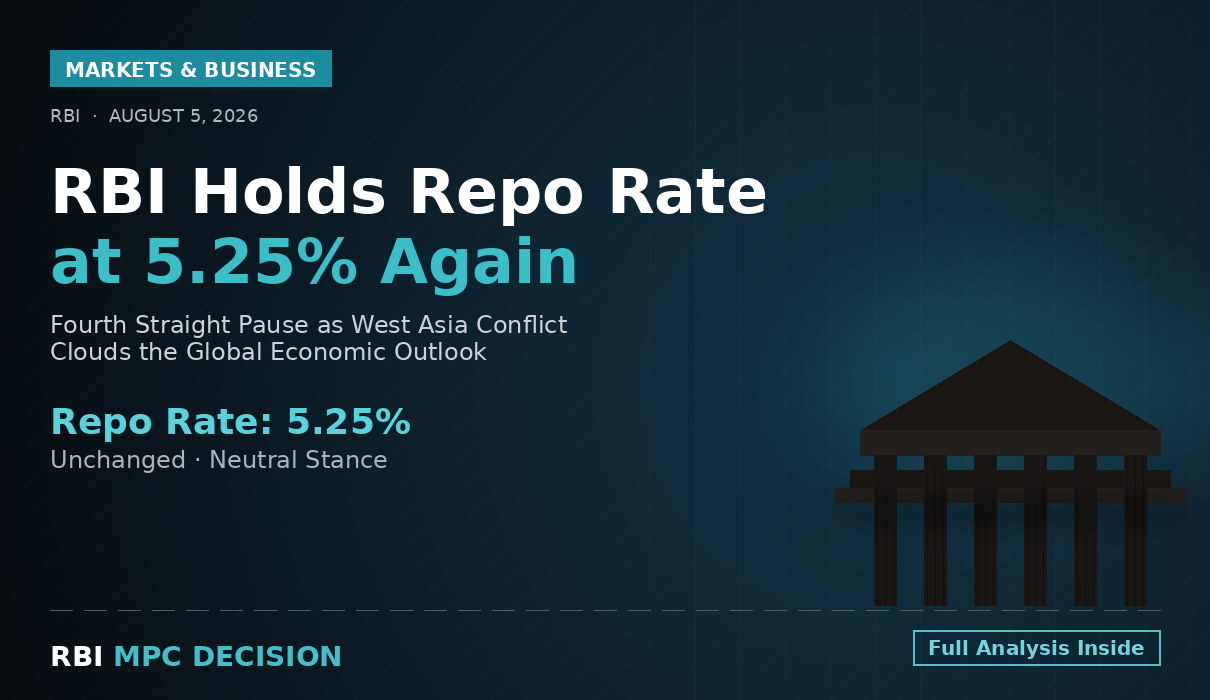
The Monetary Policy Committee unanimously voted to keep the policy repo rate unchanged at its August 3-5 meeting amid global uncertainty and volatility linked to the continuing conflict in West Asia. The rate stays at 5.25 percent, with the committee also retaining its neutral policy stance.
The knock-on numbers moved in lockstep, as they always do. The Standing Deposit Facility rate remains at 5 percent, while the Marginal Standing Facility rate and the Bank Rate continue at 5.5 percent. Announcing the decision on Wednesday, RBI Governor Sanjay Malhotra said the MPC had taken the decision after weighing evolving domestic macroeconomic and financial conditions against the broader global outlook.
This marks the fourth consecutive policy meeting where the central bank has chosen to hold rates steady, following a run of aggressive cuts through 2025 that brought the repo rate down by a cumulative 125 basis points.
Why West Asia Keeps Coming Up in RBI Statements
The most notable part of Malhotra’s commentary wasn’t really about domestic inflation numbers — it was about geopolitics. He pointed to the continuing conflict in West Asia as having disrupted trade routes and supply chains, increased market volatility, and weakened business sentiment globally.
That’s a meaningful thing for a central bank governor to say explicitly. RBI policy statements typically lean heavily on domestic CPI data, monsoon performance, and food inflation trends. When a geopolitical conflict thousands of kilometers away gets top billing in the reasoning, it tells you how tightly connected India’s monetary policy calculus has become to global energy markets and shipping routes, particularly given how much of India’s crude oil still moves through that region.
Malhotra added that global growth is expected to slow, inflation is projected to remain elevated through 2026, and uncertainty has increased as some central banks tighten policy while others stay cautious. That’s essentially a description of a world where nobody — not the US Fed, not the ECB, not the RBI — has a clean, confident read on where things are headed next.
What Analysts Are Watching Next
Ranen Banerjee, partner and leader of Economic Advisory at PwC India, framed the path forward bluntly: future MPC decisions will be more influenced by the movement of US bond yields, developments in the Middle East, and capital flows than by any single domestic data point. Banerjee also flagged that volatility in global trade and energy flows, along with uncertainty over the monsoon and food inflation risks, weighed on the RBI’s decision to hold — though he noted some optimism that inflation could moderate by the fourth quarter.
That’s a genuinely useful way to think about where this is headed. The domestic Indian economy, by most measures, is holding up reasonably well. The hesitation is coming almost entirely from outside India’s borders.
The Growth and Inflation Picture
Despite the external headwinds, the RBI isn’t sounding alarmed about India’s own growth trajectory. Economists broadly expected the central bank to maintain its FY27 GDP growth forecast at 6.6 percent, and the neutral stance being retained (rather than shifting toward a more cautious “withdrawal of accommodation” posture) suggests the committee isn’t bracing for a serious slowdown domestically.
The bigger tension is inflation. With crude oil prices elevated due to the ongoing Middle East disruption and global supply chains still adjusting, the RBI has to balance not choking off growth with rate hikes against not fueling inflation by cutting too soon. Holding steady is, in that sense, the least committal option available — it doesn’t tighten conditions further, but it also doesn’t send a signal that the central bank thinks price pressures have been tamed.
What This Means for Borrowers and Savers
For anyone with a home loan, personal loan, or business loan tied to external benchmark rates, this is straightforwardly good news in the sense that nothing gets worse. EMIs stay where they are. But if you were hoping rates would come down further after last year’s cuts, the wait continues, and Banerjee’s comments suggest that wait is tied more to what happens in West Asia and with US Treasury yields than to anything the RBI can control domestically.
For fixed deposit holders and conservative savers, the flip side applies — deposit rates aren’t likely to move meaningfully in either direction from here in the near term, since banks generally take their cues from where the repo rate sits.
The Bigger Picture
This RBI MPC meeting outcome fits a pattern that’s become familiar over the past year: a central bank that front-loaded its rate cuts in 2025, and has since shifted into a defensive, wait-and-watch posture as global conditions turned choppier. Four consecutive holds after 125 basis points of cuts isn’t indecision — it’s closer to a central bank keeping its powder dry until there’s more clarity on how the West Asia situation, US monetary policy, and India’s own monsoon-driven inflation numbers actually play out over the next few months.
The next MPC meeting will likely tell us more about whether this pause extends into a longer holding pattern, or whether easing conditions abroad open the door to another cut before the financial year is out. For now, the message from Mint Street is caution, not complacency.
What’s your take — do you think the RBI should have started easing again given India’s growth numbers, or is this caution justified given what’s happening globally? Let me know in the comments.
Tags: RBI MPC, Repo Rate, Reserve Bank of India, Monetary Policy, Sanjay Malhotra, Indian Economy
Sources: Business Standard, Forbes India, Angel One, PwC India