
 By
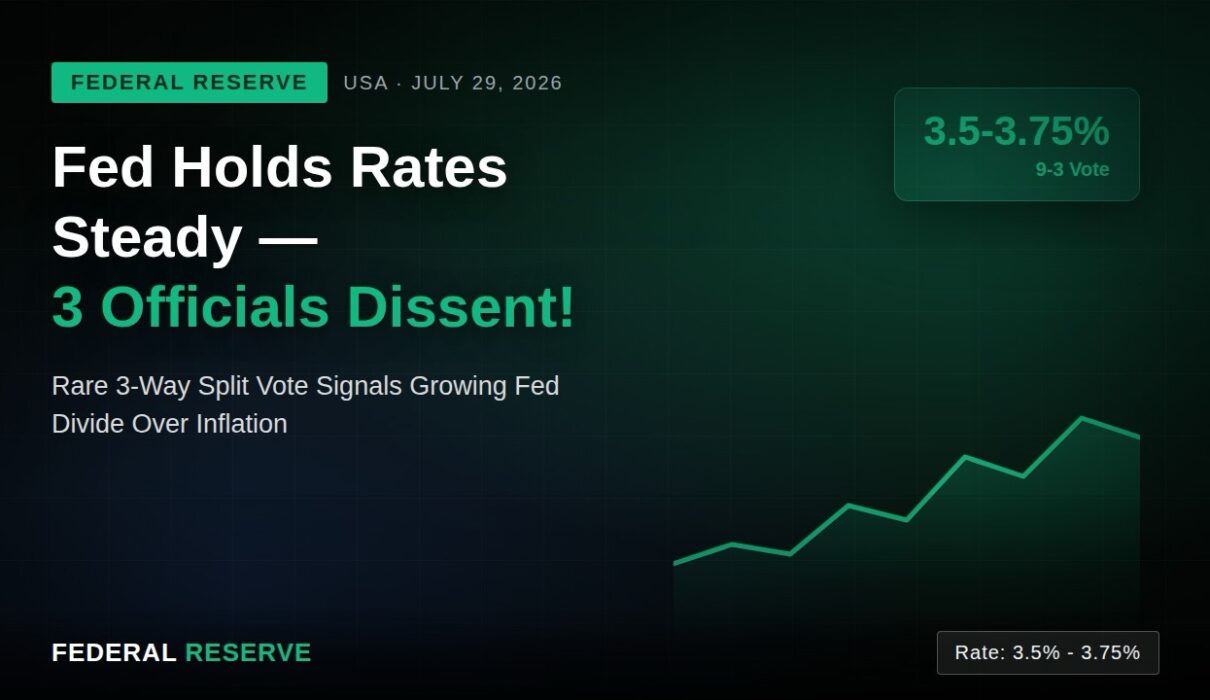
By Fed meeting interest rates decisions don’t usually make for a genuine cliffhanger, but Wednesday’s announcement was different. The Federal Reserve held its benchmark lending rate unchanged at a range of 3.5% to 3.75%, marking the fifth consecutive meeting without a change. On paper, that sounds like a quiet, predictable outcome. In reality, this was one of the closest and most contested Fed decisions in years, and the internal disagreement it revealed says a lot about where the U.S. economy stands right now.
A 9-3 Vote That Tells Its Own Story
The Federal Open Market Committee (FOMC) voted 9-3 to keep rates steady, but it’s the dissent that’s grabbing headlines. Three regional Fed presidents — Beth Hammack of Cleveland, Neel Kashkari of Minneapolis, and Lorie Logan of Dallas — voted against the decision, preferring instead to raise rates by a quarter point to get ahead of persistent inflation.
What makes this genuinely notable, in my view, isn’t just that there were dissents — it’s that all three broke in the same direction, favoring higher rates. According to Fed watchers, this marks the first time since 2016 that three policymakers have dissented together over a single policy decision. That’s a meaningful signal that the committee’s usual consensus-building process is under real strain.
Fed Meeting Interest Rates: Why the Fed Chose to Hold
New Fed Chairman Kevin Warsh, who has taken a noticeably different communication approach than his predecessors by deliberately offering less “forward guidance,” addressed the split directly at his post-meeting press conference. His now widely quoted remark — that he’d asked for “a good family fight” and got one — captures just how divided the committee currently is.
The post-meeting statement itself was almost a carbon copy of the one issued after the Fed’s June 17 decision, continuing a pattern that’s held for most of 2026 following three rate cuts late last year. Officials reiterated that “economic activity is expanding at a solid pace despite elevated uncertainty that owes, in part, to the conflict in the Middle East” — language that’s becoming a familiar refrain in nearly every recent statement.
The Iran Conflict Is Complicating Everything
A big part of what’s clouding the Fed’s decision-making right now is the ongoing conflict between the U.S. and Iran, which had reached its 152nd day as of this week’s meeting. The situation has pushed global energy prices higher, with crude oil jumping more than 7% and gasoline prices climbing around 2% around the time of the decision.
This creates a genuinely tricky situation for the Fed. Higher oil prices tend to push inflation up, which would normally argue for higher interest rates. But there’s also a long-standing view among some officials that energy-driven inflation spikes are often temporary and tend to reverse on their own without requiring a policy response — especially since interest rate changes typically take time to filter through the broader economy. That tension is essentially what’s playing out in this 9-3 vote.
Inflation Data Is Sending Mixed Signals Too
Adding to the uncertainty, recent data showed inflation actually eased sharply in June, even as the Middle East conflict intensified through July, pushing energy costs back up. That combination — cooling underlying inflation alongside a fresh energy price shock — is exactly the kind of conflicting signal that makes rate decisions genuinely difficult to call, and it’s part of why economists and investors went into this meeting with less clarity than usual about which way things would go.
What This Means for Everyday Borrowing Costs
For consumers and small businesses, the Fed holding rates steady means borrowing costs are staying elevated for now — and that’s already having a visible effect on the economy. Reports note that current interest rates have pushed the cost of borrowing out of reach for many smaller businesses and consumers, cutting into sales of big-ticket, typically financed purchases like autos and industrial equipment.
At the same time, for savers, the current rate environment continues to support relatively attractive returns on savings accounts and CDs — a silver lining that often gets less attention in coverage of Fed decisions, but matters just as much to everyday households.
Markets React With a Sell-Off
Investors had largely priced in a hold going into Wednesday’s meeting, with economists polled by FactSet predicting exactly this outcome. Even so, markets sold off following the announcement — the Dow Jones Industrial Average dropped around 1.5% shortly after the decision, while the S&P 500 and Nasdaq Composite each slipped roughly 0.6%. That reaction suggests investors were less concerned about the hold itself and more unsettled by the unusually visible three-way dissent and the uncertainty it signals about the Fed’s next move.
What Happens at the Next Meeting?
Perhaps the most interesting fallout from Wednesday’s decision is what it’s done to expectations for September. Immediately after the announcement, the odds of a quarter-point rate hike at the Fed’s next policy meeting rose to 59%, according to the CME FedWatch tool — meaning markets now see a rate increase, not a cut, as the more likely outcome next time around.
That’s a notable shift in tone. For much of the past year, market conversation around the Fed centered on when cuts might resume. Now, with inflation concerns resurfacing and three influential regional presidents publicly pushing for tighter policy, a hike is suddenly back on the table as the more probable path.
Final Thoughts
This week’s Fed meeting on interest rates may have technically ended in “no change,” but it was anything but a routine, forgettable decision. Between the rare three-way dissent, an unusually communicative-yet-vague new chairman, an active Middle East conflict distorting energy prices, and inflation data sending mixed messages, the Fed finds itself navigating one of its most genuinely uncertain stretches in years. Whatever happens in September, it’s clear the committee’s internal debate over inflation risk is far from settled.
Do you think the Fed should have raised rates this time to get ahead of inflation, or was holding steady the right call given everything else going on? Let us know in the comments.
Sources: CNBC, CNN Business, NBC News, CBS News, Yahoo Finance
Disclaimer: This article is for informational purposes only and does not constitute financial advice. Please consult a qualified financial advisor before making any investment or borrowing decisions.