

 By
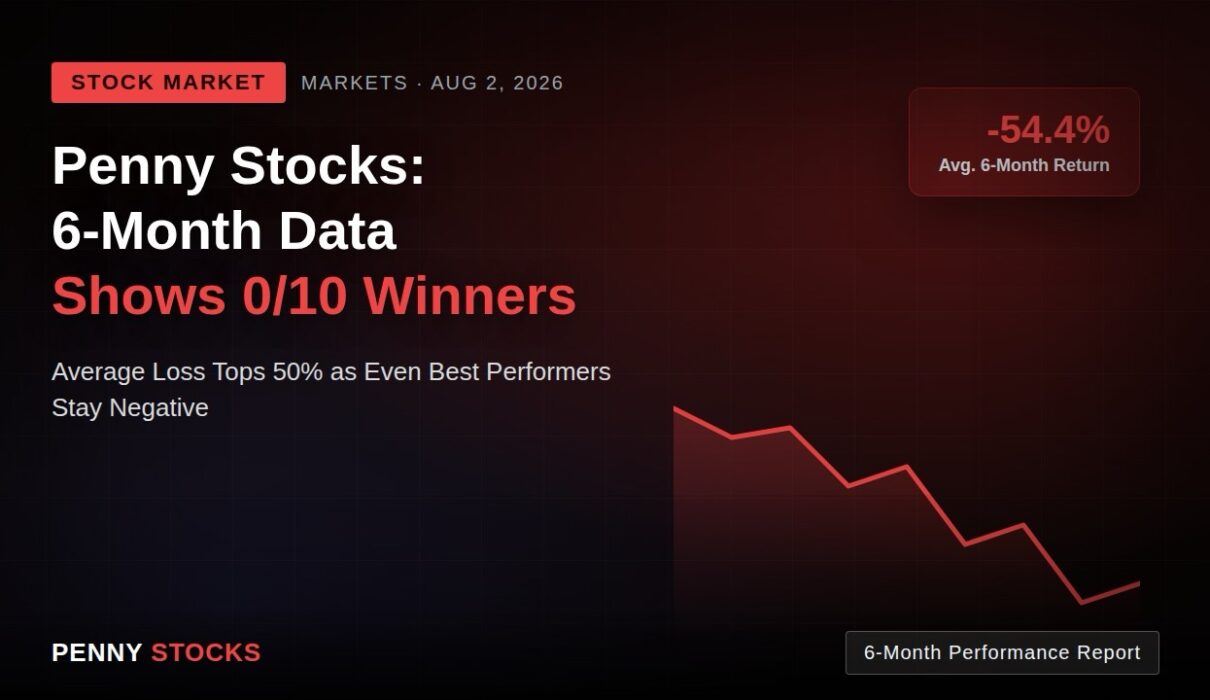
By Six month penny stock performance data released this week paints a genuinely sobering picture for anyone who’s been chasing quick gains in this corner of the market. According to the latest tracking data from AltIndex, a basket of ten widely-followed penny stocks delivered an average six-month return of negative 54.4% — and not a single one of the ten managed to finish in positive territory. If you’ve been holding penny stocks over the past six months hoping for a turnaround, this data suggests you’re far from alone in feeling the pain.
The Numbers Behind the Slump
Let’s look at exactly how rough this stretch has been. Among the tracked tickers, Worksport dropped 67%, AuthID fell 60.7%, SCWorx tumbled 78.8%, and Lucid Diagnostics slid 26.1% over the six-month period. Even the “best” performer in this particular basket, Tenaya Therapeutics, still finished down 3.9% — meaning there was no genuine winner among this group of ten stocks. At the other extreme, BiomX lagged badly with a staggering 96.9% decline, effectively wiping out almost the entire value of anyone holding the stock at the start of the period.
In my opinion, what makes this data particularly useful isn’t just the headline average — it’s the fact that zero out of ten stocks were positive. That’s a meaningfully different story than a simple “average return” figure might suggest, because it shows this wasn’t just one or two bad apples dragging down an otherwise decent group. This was a genuinely broad-based decline across the entire basket.
So Why Do People Still Buy Penny Stocks?
Given numbers like these, it’s fair to wonder why penny stocks — typically defined as stocks trading below $5 per share, often representing smaller or newer companies — continue to attract so much investor attention. Part of the answer lies in the flip side of this same volatility. According to FinanceCharts data, the best-performing penny stock over the trailing 12 months has been NuRAN Wireless (NRRWF), which delivered a jaw-dropping total return of 29,550.35% — a figure that, frankly, is almost impossible to imagine happening with any large-cap, established stock.
That’s the fundamental appeal and the fundamental trap of penny stocks in one sentence: the same volatility that can turn a small investment into a life-changing sum can just as easily wipe out most or all of your capital within the same stretch of time. For every NuRAN Wireless story that makes headlines, there are dozens of quieter BiomX-style collapses that most investors never hear about until it’s their own portfolio taking the hit.
Not Every Corner of the Penny Stock World Looks the Same
It’s worth noting that “penny stocks” isn’t really one uniform category — the space includes everything from speculative biotech firms burning through cash with no revenue, to smaller but genuinely profitable operating businesses. Some examples from recent screening reports illustrate this contrast well.
BRC Inc., which operates in the coffee roasting and consumer products space, reported $109.23 million in Q1 2026 sales, up from $89.97 million a year earlier, while simultaneously reducing its net loss to just $0.015 million — a business that’s clearly moving in the right direction even while technically classified as a penny stock by market cap.
Similarly, Xtra-Gold Resources, a pre-revenue gold exploration company, reported being debt-free with short-term assets of $18.2 million significantly exceeding liabilities of just $1.7 million, along with a net income of $1.21 million for Q1 2026 and earnings growth accelerating to 35.8% over the past year. Financial screening services have specifically flagged this kind of balance sheet strength as a differentiator between speculative penny stocks and genuinely investable smaller companies.
This distinction matters a lot when you’re looking at six-month performance data. A stock like BiomX, likely still in a pre-revenue or early clinical stage with no meaningful income, behaves completely differently from a company like BRC Inc., which has real, growing revenue streams and shrinking losses.
What This Data Actually Tells Investors
If there’s one takeaway from this six-month performance data, it’s that broad, unfiltered exposure to penny stocks has historically been a losing strategy over shorter time horizons. An equal-weighted basket approach — essentially picking a handful of popular or frequently-discussed penny stocks without deeper fundamental analysis — resulted in more than half of invested capital being lost on average over just six months.
This doesn’t necessarily mean penny stocks as an asset class should be avoided entirely. Rather, it reinforces something that financial analysts have repeated for years: penny stock investing tends to reward deep due diligence — looking at debt levels, cash runway, revenue trends, and management experience — far more than it rewards simply following momentum or popularity. Screening tools now commonly used by investors specifically flag red flags like management teams with limited tenure (in some cases averaging under two years) or rising debt levels over a five-year period as early warning signs worth investigating before buying in.
The Broader Market Context
It’s also worth situating this penny stock weakness within the broader market picture. Even as penny stocks have struggled, the overall US market has been up somewhere in the range of 17% to 31% over the trailing 12 months, according to various screening reports from earlier in 2026, with earnings growth forecasts in the high-teens percentage range annually going forward. That contrast is telling — while broader indices and larger, more established companies have generally trended upward this year, penny stocks as a group have moved in the opposite direction over the more recent six-month window, highlighting just how disconnected this segment of the market can become from overall market sentiment.
A Word of Caution
Given how extreme both the gains and losses can be in this space — a nearly 30,000% winner sitting alongside stocks that lost 60%, 70%, even close to 97% of their value in the same general timeframe — penny stocks remain one of the highest-risk categories available to everyday retail investors. Extreme volatility, thin trading volumes, limited analyst coverage, and in many cases, unproven business models all contribute to outcomes that are genuinely difficult to predict, even for experienced investors.
Final Thoughts
The latest six-month penny stock performance numbers serve as a useful reality check for anyone drawn to this segment of the market by stories of massive overnight gains. While standout performers like NuRAN Wireless do exist and genuinely happened, the far more common outcome — as shown by an average decline of over 54% across a tracked basket with zero winners — is significant capital loss over relatively short periods. As always, this kind of extreme volatility underscores the importance of thorough research, careful risk management, and never investing more than you can afford to lose in any single speculative position.
What’s your experience been with penny stocks over the past six months — have you seen similar losses, or did you find one of the rare winners? Let us know in the comments.
Sources: AltIndex, FinanceCharts, Simply Wall St, Yahoo Finance
Disclaimer: This article is for informational purposes only and does not constitute financial or investment advice. Penny stocks are highly volatile and speculative investments. Please consult a qualified financial advisor and conduct your own research before making any investment decisions.