
 By
By Protein and aging research just took a genuinely confusing turn, and if you’ve been dutifully adding an extra scoop of protein powder to your morning routine because you read somewhere that it fights aging, you might want to keep reading before you buy the next tub.
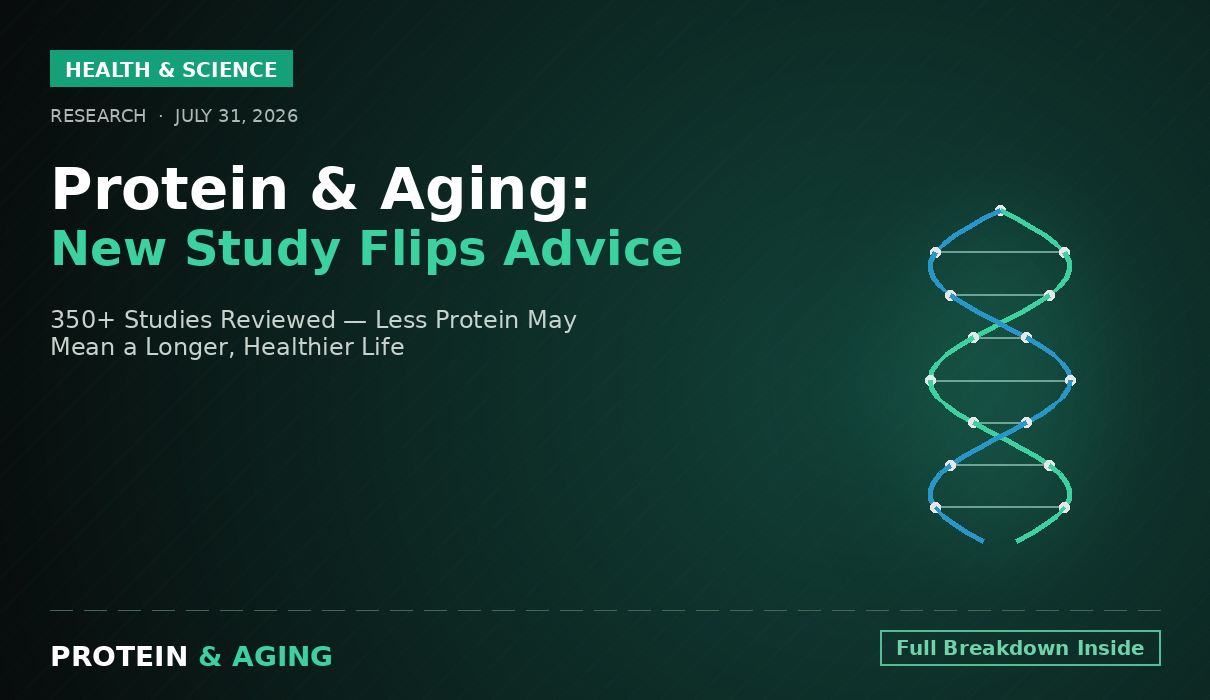
A sweeping review of more than 350 studies published on July 31, 2026 in the journal Cell Press Blue suggests that the protein boom currently taking over grocery stores may be overselling what most people actually need — and that eating less protein, not more, could be the better move for long-term health. That’s a direct challenge to years of dietary advice, government guidelines, and pretty much every protein bar wrapper you’ve picked up in the last five years.
Why This Study Is Landing at a Strange Moment
The timing here is almost ironic. Just this year, US health authorities updated their dietary guidelines to recommend increasing daily protein intake to 1.2 to 1.6 grams per kilogram of body weight — nearly double the previous recommendation. A 2025 consumer report found that 61% of Americans had increased their protein intake over the previous year, up sharply from just 48% in 2019. Food companies noticed, and protein-enriched products have since flooded grocery store shelves, showing up in everything from cereal and coffee to bottled water.
So right as the entire food industry pivots hard toward “more protein, always,” a massive academic review lands saying the opposite might be true, at least for a meaningful chunk of the population.
Who’s Behind This Research
The review was led by Dudley Lamming, a professor at the University of Wisconsin-Madison, who examined existing data on whether restricting protein — and specific amino acids in particular — promotes the kind of cellular processes linked to healthy aging and longevity. This isn’t a single small study; the team drew on more than 350 published papers to build their case, which is the kind of scope that’s hard to dismiss outright, even if the conclusions are controversial.
Lamming isn’t arguing that protein is bad, though. He’s been direct about that distinction, saying it’s absolutely clear that protein benefits muscle growth and the exercise response of people who are actually active. The nuance matters a lot here, and it’s the part that’s getting lost in a lot of the headlines currently circulating.
The Actual Mechanism
Here’s where it gets genuinely interesting from a biology standpoint. One of the key players identified in the review is a hormone called fibroblast growth factor 21, or FGF21, which rises when protein intake is low. This hormone appears to be connected to several of the metabolic benefits the researchers associate with eating less protein.
The review also singles out specific amino acids — methionine, isoleucine, and valine — as the ones that seem to drive much of the effect, rather than protein restriction being a blunt, across-the-board benefit. That’s an important nuance: the researchers found that restricting these specific amino acids recreates many of the same benefits as broader protein restriction, which suggests the composition of your protein sources might matter as much as the total amount you’re eating.
In plain terms: it’s not just “eat less protein overall.” It’s that certain building blocks within protein — found in different concentrations depending on whether you’re eating red meat, dairy, legumes, or fish — may be doing most of the metabolic heavy lifting when it comes to aging pathways.
But There’s a Very Real Counter-Argument
Before you start cutting back on chicken breast, it’s worth knowing this debate is genuinely split, and not everyone in the research community agrees with Lamming’s take.
Just weeks before this review came out, a separate perspective paper published on June 16, 2026 in Frontiers in Nutrition argued the exact opposite — that current public health protein guidelines are outdated because they’re designed to prevent deficiency disease, not to maximize long-term health. That paper, from Chris Macdonald at the University of Cambridge, suggested people could benefit from roughly doubling their protein intake beyond current recommended minimums, up to around 1 gram per pound of body weight, to support muscle recovery, strength gains, fat loss, and bone health.
So within about six weeks of each other, two credible academic publications came out making essentially opposite arguments. That’s not a sign either side is wrong — it’s a sign that the actual answer is more complicated than either headline suggests, and probably depends heavily on who’s asking the question.
The Detail Almost Everyone Is Missing
Here’s the part of the new review that deserves more attention than it’s getting: Lamming has specifically noted that recent recommendations have pushed people to eat more protein while also encouraging more exercise, and that protein needs should probably be personalized based not just on age, but on how physically active a person actually is.
That’s a meaningfully different message than “protein is bad” or “protein restriction extends life for everyone.” A sedentary 60-year-old and an active 60-year-old who lifts weights three times a week are, according to this framing, not the same person nutritionally, even if they’re the same age and weight. Some coverage of the review has specifically flagged that higher protein intake may be doing more harm than good for people who lead largely sedentary lifestyles and don’t actually need the extra intake their bodies aren’t using for muscle repair or growth.
Important Caveats Before You Change Anything
It’s also worth being upfront about a limitation buried in the coverage: the underlying research is still largely limited to animal studies, and experts don’t see strong evidence yet for the idea that healthy humans should actively restrict protein or specific amino acids. Exercise remains the piece researchers consistently emphasize as important regardless of which side of the protein debate you land on.
That’s a meaningful caveat. A review of 350 papers is impressive in scope, but a review is still a synthesis of existing evidence, not a new clinical trial in humans. The mechanisms around FGF21 and specific amino acid restriction are compelling in mice and other organisms, but translating that cleanly to “here’s exactly how many grams of protein a 45-year-old office worker should eat” is a much bigger leap than the headlines suggest.
What Older Adults Specifically Should Know
This gets more complicated once you factor in existing research on aging populations specifically. Separate research on very old adults has found that protein intake naturally tends to be lower in older adults compared to younger ones, and that a meaningful share of elderly populations already fall below the standard recommended daily protein allowance due to factors like reduced appetite, changes in taste perception, and health conditions that make eating harder.
That’s a genuinely different problem from the one this new review is addressing. There’s a real difference between “healthy, active adults may be over-consuming protein because of marketing trends” and “frail elderly adults may already be under-consuming protein in ways that contribute to muscle loss and frailty.” Both things can be true at once, for different populations, which is exactly why blanket protein advice — in either direction — tends to fall apart on closer inspection.
The Bottom Line
This is one of those research stories where the honest answer is genuinely “it depends,” and anyone selling you a definitive one-size-fits-all protein rule right now, in either direction, is probably oversimplifying a debate that credentialed researchers themselves haven’t resolved.
What seems reasonably solid across both sides of this argument: exercise matters more than any protein number by itself, sedentary people probably don’t need as much protein as the current aggressive marketing suggests, frail or very elderly adults are a genuinely different case who may need more support rather than less, and the specific type of protein you’re eating (and its amino acid profile) may matter as much as the raw gram count.
The protein aisle isn’t going anywhere anytime soon. But the next time you see a product bragging about its protein content, it might be worth asking whether you actually need it, rather than assuming more is automatically better.
What’s your take — are you Team More Protein or Team Less Protein after reading this? Let me know in the comments.
Sources: ScienceDaily, Forbes, Medical News Today, News-Medical, Cell Press Blue (Cell.com), FOX 5 New York