
 By
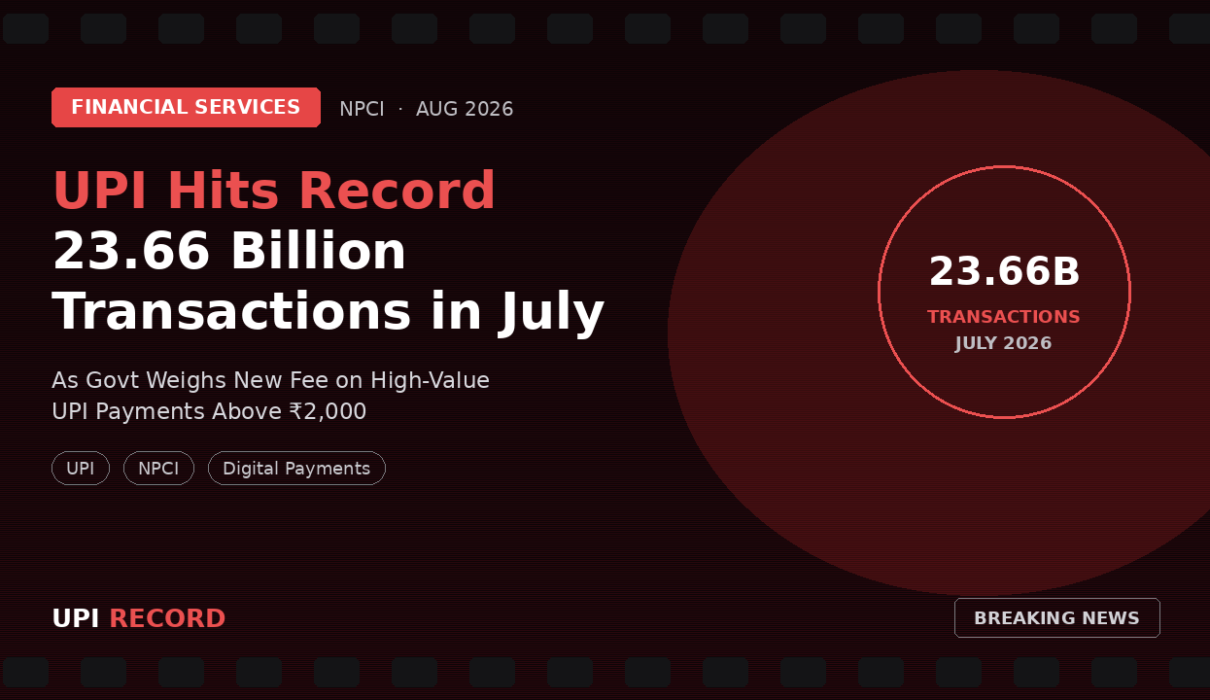
By This UPI transactions record 2026 milestone arrived in an unlikely month. July usually isn’t a month anyone associates with spending sprees. No festival rush, no year-end settlements, none of the usual triggers that push payment numbers up. And yet UPI just had its biggest month ever — 23.66 billion transactions worth ₹29.88 lakh crore, according to fresh NPCI data. At the same time, Parliament is quietly working through a bill that could put a price tag on some of those transactions for the first time since 2020. Two stories, same week, and they’re worth untangling together.
The Numbers, Plainly
NPCI’s July figures show UPI moved past its previous record — 23.20 billion transactions set back in May — to hit 23.66 billion transactions in a single month. That works out to roughly 763 million transactions a day, or about ₹96,383 crore moving through UPI rails every single day of the month. Compared to June, volume was up 4.1%, value up 3.3%. Compared to July last year, the jump is a lot steeper: 22% more transactions, 19% more value.
What actually stands out here isn’t the record itself — UPI’s been setting new records more or less every few months for years now — it’s the reasoning industry watchers are offering for why. Cashfree co-founder Reeju Datta pointed out that July had none of the usual tailwinds: no big festival, no quarter-end business settlements, nothing structural pushing numbers up artificially. If that reading holds, this was just an ordinary month of Indians paying for ordinary things — chai, groceries, autos, electricity bills — at a scale that’s become genuinely hard to visualize.
There’s a second detail buried in the data that’s arguably more interesting than the headline number: transaction volume is growing faster than transaction value. In plain terms, people aren’t necessarily spending more per transaction — they’re just using UPI for more things, more often, in smaller amounts. That tracks with what a lot of us have noticed anecdotally — five years ago you’d pull out cash for a ₹20 chai; now you scan a code without thinking twice.
Who’s Actually Running the Show
NPCI hasn’t published app-wise numbers for July yet, but June’s breakdown gives a decent picture. PhonePe is still comfortably out front with 10.48 billion transactions for the month, with Google Pay and Paytm rounding out the top three. One smaller shift worth flagging: WhatsApp Pay quietly overtook CRED in transaction volume, processing 150.48 million transactions against CRED’s 141.78 million. Not a huge number in the context of billions, but it says something that a messaging app’s payment feature is now outpacing a dedicated fintech product.
The Part That Could Actually Cost Someone Money
Here’s where this stops being just a “look how big the numbers got” story. Alongside the record-setting data, the Finance Ministry has tabled amendments to the Payment and Settlement Systems Act through the Taxation and Other Laws (Amendment) Bill, 2026 — and buried in that legal language is a change that would let banks and payment providers charge merchants a fee on certain UPI transactions for the first time since MDR was scrapped in January 2020.
The number being discussed is a Merchant Discount Rate of somewhere between 0.25% and 0.5%, applying only to UPI payments above ₹2,000, and reportedly only for merchants with annual turnover above ₹1.5 crore. Person-to-person transfers — the money you send a friend or family member — wouldn’t be touched. Neither would small businesses or everyday low-value purchases, at least under the version of the proposal currently being discussed.
It’s worth being precise about what’s actually happened versus what’s still speculative. The bill creates the legal framework that would allow MDR to be reintroduced on notified digital payment modes in the future — it doesn’t impose a fee today. No rate has been finalized, no date has been set, and the Finance Ministry, RBI, and NPCI haven’t officially commented. This is a first legislative step, not a done deal.
Government data cited in the reporting gives a sense of why this specific threshold was chosen: transactions above ₹2,000 make up only around 5% of total UPI volume, but they account for nearly 65% of total transaction value. In other words, this is a proposal engineered to touch the smallest possible slice of transactions while capturing the largest possible slice of money moving through the system — which is presumably the point.
Why Now, After Five Years of Zero Fees
The zero-MDR policy on UPI has been a genuine success story for adoption — it’s a big part of why a shopkeeper with a ₹500 daily turnover and a Fortune 500 company both use the same free payment rail. But payment companies have argued for years that “free forever” isn’t sustainable if the infrastructure is expected to keep scaling, adding fraud protection, and expanding internationally. The government has run an incentive scheme to subsidize small-merchant UPI costs since 2021-22, paying out ₹3,631 crore in FY2023-24 alone — money that’s essentially been covering the gap left by zero MDR. A merchant fee on high-value transactions would, in theory, shift some of that cost back onto the transactions large enough to absorb it.
It’s also not the first time this exact rumor has circulated. Back in April 2025, the Finance Ministry had to publicly deny reports that it was considering GST on UPI transactions above ₹2,000, calling those reports “completely false, misleading and baseless.” This time is different in one important way — there’s now an actual bill in Parliament, not just a report the ministry has to knock down.
What This Actually Means for You
If you’re an individual sending money to friends or family, or making routine purchases under ₹2,000 — which is the overwhelming majority of daily UPI use — none of this changes anything. If you run a business processing high-ticket UPI payments and cross the ₹1.5 crore turnover threshold, this is worth watching closely over the next few Parliament sessions, because it could eventually mean absorbing a small percentage on larger transactions.
For now, the bigger story is simply this: UPI has become so deeply embedded in how India pays for things that a policy debate over a fraction of a percent on high-value transactions is now front-page financial news. Whether that MDR proposal survives in its current form, gets watered down, or quietly disappears the way the GST rumor did last year — that’s the thread worth following into the festive season, when both transaction volumes and political attention to this bill are likely to climb together.
Sources: NPCI, Business Standard, Storyboard18, The Federal, Indian Television Dot Com, Entrackr